Topository T-shirts Knowledge worth wearing
  1. Brachiosaurus Brachiosaurus was a gigantic Jurassic herbivore, reaching about 12 metres tall, with long forelimbs, a high-reaching neck, and teeth adapted for browsing tall vegetation.
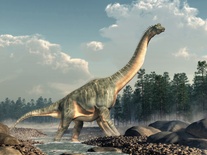
    Brachiosaurus was a gigantic Jurassic herbivore, reaching about 12 metres tall, with long forelimbs, a high-reaching neck, and teeth adapted …
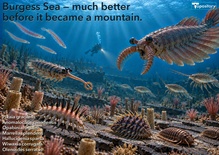
  2. Burgess Shale The Burgess Shale is a Canadian fossil Lagerstätte that continues to reveal extraordinary marine fossils, offering a window into life during the Cambrian explosion over 500 million years ago.

    The Burgess Shale is a Canadian fossil Lagerstätte that continues to reveal extraordinary marine fossils, offering a window into life …

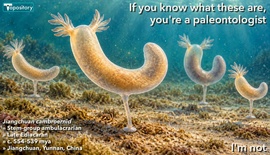
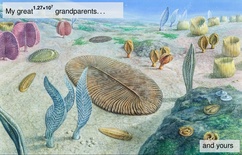
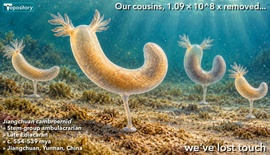
  3. Cambroernid 01 Reconstructed cambroernids from Jiangchuan, Yunnan, China, lived around 554-539 million years ago. Interpreted as early ambulacrarians, they belong near the lineage containing starfish and acorn worms. Their stalked bodies and feeding tentacles evoke our distant evolutionary kinship, but, sadly, 'we've lost touch'.

    Reconstructed cambroernids from Jiangchuan, Yunnan, China, lived around 554-539 million years ago. Interpreted as early ambulacrarians, they belong near the …

  4. Cambroernid 02 Jiangchuan cambroernids were U-shaped seafloor animals with stalks and feeding tentacles. Their Late Ediacaran fossils, about 554-539 million years old, illuminate the early history of ambulacrarians, relatives of echinoderms and acorn worms. You'd need to be a palaeontologist to appreciate them.

    Jiangchuan cambroernids were U-shaped seafloor animals with stalks and feeding tentacles. Their Late Ediacaran fossils, about 554-539 million years old, …

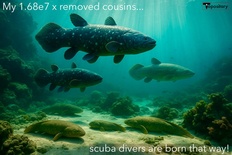
  5. Coelacanths / lungfish Coelacanths and lungfish are ancient lobe-finned fish; lungfish are tetrapods’ closest living relatives, sharing a common ancestor about 420 million years ago. They are an important step in the transition to land animals, (and scuba divers).

    Coelacanths and lungfish are ancient lobe-finned fish; lungfish are tetrapods’ closest living relatives, sharing a common ancestor about 420 million …

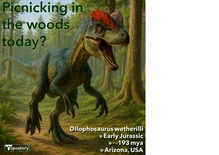
  6. Dilophosaurus Dilophosaurus was a large Early Jurassic predator from North America, recognised by two delicate skull crests. Fossils provide no evidence for the venom-spitting, neck-frilled animal of films.

    Dilophosaurus was a large Early Jurassic predator from North America, recognised by two delicate skull crests. Fossils provide no evidence …

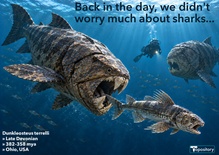
  7. Dunkleosteus Dunkleosteus was a giant armoured fish of the Late Devonian, around 382–358 million years ago. It grew up to 9m long and instead of teeth, it's self-sharpening bony jaw blades sliced through prey.

    Dunkleosteus was a giant armoured fish of the Late Devonian, around 382–358 million years ago. It grew up to 9m …

  8. Ediacaran Fauna Ediacaran Fauna shows mysterious soft-bodied organisms that flourished before the Cambrian explosion, roughly 635–539 million years ago, when complex multicellular ecosystems first became significant.

    Ediacaran Fauna shows mysterious soft-bodied organisms that flourished before the Cambrian explosion, roughly 635–539 million years ago, when complex multicellular …

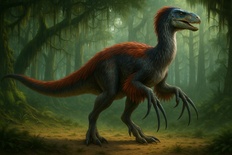
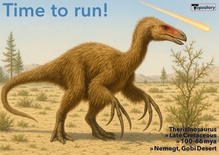
  9. Forest Therizinosaurus Therizinosaurus was a large plant-eating theropod that lived in Mongolia around 70 million years ago, during the Late Cretaceous. It is best known for its exceptionally long hand claws. This artwork depicts the dinosaur in a forest setting.

    Therizinosaurus was a large plant-eating theropod that lived in Mongolia around 70 million years ago, during the Late Cretaceous. It …

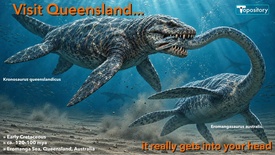
  10. Kronosaurus and Eromangasaurus Kronosaurus queenslandicus was a powerful, short-necked pliosaur; Eromangasaurus australis was a long-necked elasmosaur. Both inhabited Queensland's Early Cretaceous Eromanga Sea around 100 million years ago. This imagined encounter pairs prehistoric marine reptiles with a darkly humorous invitation to visit Queensland.

    Kronosaurus queenslandicus was a powerful, short-necked pliosaur; Eromangasaurus australis was a long-necked elasmosaur. Both inhabited Queensland's Early Cretaceous Eromanga Sea …

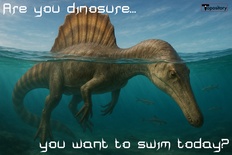
  11. Spinosaurus Spinosaurus was a sail-backed Cretaceous predator whose crocodile-like jaws and conical teeth were adapted for catching fish. It hunted around North African rivers and wetlands.

    Spinosaurus was a sail-backed Cretaceous predator whose crocodile-like jaws and conical teeth were adapted for catching fish. It hunted around …

  12. Therizinosaurus 01 Therizinosaurus belonged to the theropods, the dinosaur group that includes birds and many meat-eaters. Evidence from its close relatives indicates that it was primarily herbivorous, illustrating how this lineage evolved very different feeding habits. It lived in Late Cretaceous Mongolia.

    Therizinosaurus belonged to the theropods, the dinosaur group that includes birds and many meat-eaters. Evidence from its close relatives indicates …